

China is home to many manufacturers producing silicone hoses for passenger vehicles, commercial fleets, and specialist applications. Choosing among them takes more than comparing prices or browsing polished product photos. A useful supplier review looks at materials, manufacturing controls, testing, and the ability to meet a specific design.
A Silicone Automotive Hose may carry coolant or pressurized intake air, depending on its construction and intended use. Its performance depends on details such as reinforcement layers, wall thickness, bend radius, and fit at each connection. Small details matter. A hose that looks correct on a screen may still kink near a tight engine-bay bend or fail to seat securely against a pipe bead. Ask manufacturers for technical data, application guidance, and test results relevant to the operating conditions—not just broad claims about heat resistance.
This guide explores China’s leading silicone automotive hose manufacturers and the factors buyers can use to assess them. These include production experience, quality checks, customization capacity, communication, and documentation. Rankings can vary by product range and project needs, so “top” should not be treated as a universal label. Request samples where practical, confirm dimensions against drawings, and clarify how batches are identified and inspected. Even then, supplier information deserves careful review. A strong brochure is useful, but it is not proof of consistent performance.
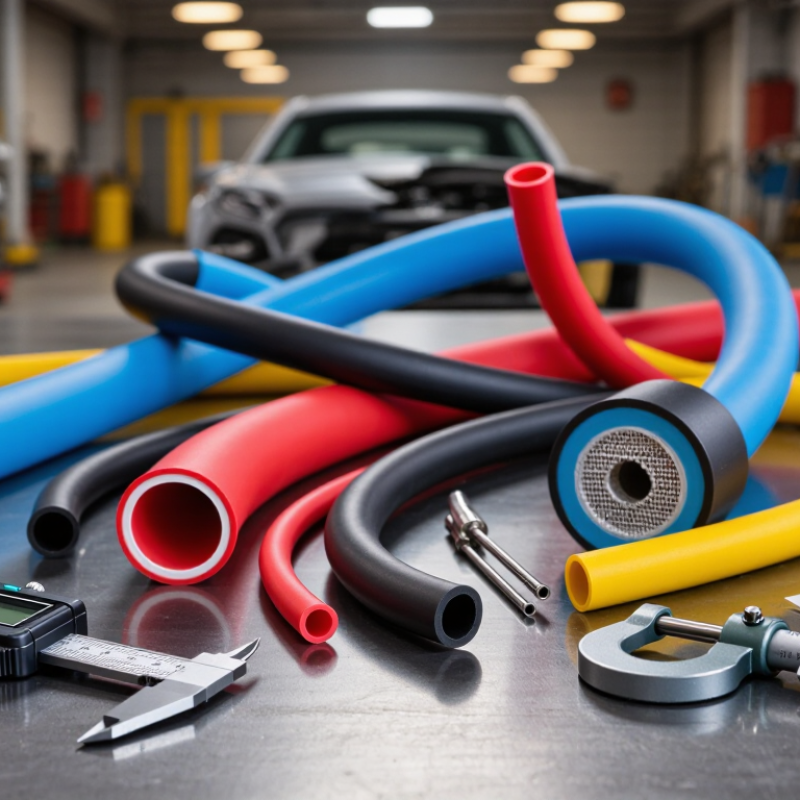
China Top Silicone Automotive Hose Manufacturers
Silicone Automotive Hoses: Types and Typical −50°C to 200°C Service Range
Silicone automotive hoses come in straight, elbow, reducer, and hump shapes. Reinforced multi-ply versions help manage pressure and movement in demanding engine bays. You’ll often find them carrying coolant or routing intake air between a turbocharger and intercooler. Fit matters: a tight bend can flatten the hose and restrict flow.
Selected silicone compounds are commonly rated for service from about −50°C to 200°C. That range is not a guarantee for every hose or installation. Continuous heat, pressure, fluid exposure, and nearby exhaust parts all affect service life. Check the hose specification and temperature rating for its intended use. A chart alone can mislead.
Look closely at the details. Are the inner diameter and bend angle correct? Do the clamps sit behind the reinforcing bead? Silicone handles heat well, but it is not suitable for every fluid or connection. It can also soften or wear when poorly supported. I would treat the temperature range as a starting point, not a target. Real engine bays are less tidy than test conditions.
Silicone automotive hoses are commonly designed for service across a broad temperature range. The ranges shown are representative, not universal ratings; actual limits depend on hose construction, reinforcement, media, pressure, and whether exposure is continuous or intermittent. Check the product specification for the intended application.
Chinese automotive hose makers shape silicone through controlled compounding and extrusion. Engineers blend silicone rubber with heat-resistant additives, then extrude it through a die to form a smooth inner tube. Fabric or polyester reinforcement is applied in layers, often over a mandrel, to help the hose resist pressure and retain its shape. The assembly is then cured with controlled heat. Small errors matter. Uneven reinforcement or incomplete curing can weaken a hose even when its surface looks flawless. Grand View Research estimated the global silicone market at US$18.2 billion in 2023, reflecting the material’s broad industrial use—not a measure of hose quality.
Tips: Ask suppliers how they control wall thickness and reinforcement placement. Request batch records and test results, not just a polished sample. A sample can hide process variation.
Testing should check dimensions, tensile strength, elongation, heat aging, and pressure performance. ASTM D412 provides methods for measuring rubber tensile properties, while SAE J20 covers automotive coolant-hose performance requirements. Factories may also run leak and burst-pressure checks on finished hoses. Test conditions matter: a pass at room temperature does not prove durability after heat exposure. Buyers should compare results under clearly stated conditions and confirm that the tested construction matches the production hose.
China Top Silicone Automotive Hose Manufacturers
SAE J20, ISO 9001, and Key Automotive Hose Quality Checks
SAE J20 provides performance requirements for automotive coolant hoses, but buyers should confirm the applicable hose type and current edition. Silicone’s heat resistance makes it useful in demanding engine-bay conditions; it does not make every hose suitable for every coolant or pressure. Check the stated temperature range, dimensions, reinforcement, and fitting compatibility before ordering. Small differences matter. A hose that looks right on a bench may kink once installed.
Quality checks should go beyond paperwork. Ask for pressure, burst, impulse, and heat-aging test results, plus dimensional inspection records. Where relevant, check vacuum resistance and leakage around connections. The ISO Survey 2022 reported 1,265,216 valid ISO 9001 certificates worldwide. That figure shows the standard’s broad use, not that every certified site makes automotive hoses or that each hose passes performance tests. Confirm the certificate’s scope and request traceable, batch-specific test data.
Tips: Measure the installed route, including bends and clearance from hot components. Compare test conditions with your actual operating temperatures and pressures. A tidy report helps, but it cannot replace a fit check on the vehicle.
Chinese silicone automotive hose manufacturers support applications ranging from coolant circulation to turbocharger connections. Their capabilities may include silicone compounding, fabric reinforcement, mandrel forming, curing, trimming, and dimensional inspection. Hose constructions vary by temperature, pressure, bend radius, and exposure to oil or coolant. These details matter: a thick wall alone does not guarantee a suitable hose.
More experienced producers can discuss material grades, reinforcement layers, and operating limits before recommending a design. They may provide custom diameters, bends, and prototypes, then check samples for dimensions, appearance, and pressure performance. Ask how test conditions match the vehicle’s actual service environment. A polished sample is not enough. Request written specifications and inspection records, and compare them with your application requirements.
Production scale and export experience can help with repeat orders, but neither proves consistent quality. Check whether the supplier controls batch variation and can trace materials through production. Clear drawings and realistic lead times are useful signs. Still, even a careful process can miss a detail; verify fitment with a trial installation. That deserves a second look.
How to Compare Suppliers by Pressure, Temperature, Fit, and OEM Requirements
When comparing silicone automotive hose suppliers in China, check the working conditions before comparing quotes. Ask for the hose’s rated pressure and temperature range, and confirm whether ratings apply continuously or only briefly. A coolant hose near an engine may face heat, vibration, and pressure cycles together. A single maximum-temperature figure does not tell the whole story. Request test data for the intended application, not just a general product sheet.
Fit matters just as much as material. Share the vehicle or assembly details, connection dimensions, bend radius, and available clearance. Confirm whether the hose can be supplied with the required diameter, length, reinforcement, and end shape. For OEM projects, also discuss drawing control, sample approval, batch traceability, and change notifications. These details can prevent a hose from rubbing against a bracket or kinking during installation. Still, drawings may miss real-world movement. A trial fit is worth the extra time.
Tips: Compare suppliers using the same specification sheet. Ask for samples, inspect the inner bore and cut edges, and check fit under realistic routing. Keep records of approved dimensions and test conditions. One judgment call remains: the cheapest option may not be the easiest to validate.