

Choosing Meat Processing Equipment in 2026 is not simply a matter of buying faster machines. The right setup must suit your product mix, daily volume, floor space, and operators’ experience. A grinder that performs well on one shift may struggle during a long production run. Small details matter. Check how easily staff can clean contact surfaces, change blades, and reach controls. Ask suppliers to demonstrate routine changeovers, not just ideal operating conditions. Brochures rarely show a stubborn latch or a poorly placed washdown connection.
Temple Grandin, a meat-industry expert in animal handling and facility design, has said, “I think using animals for food is an ethical thing to do, but we’ve got to do it right.” Her statement is not a machinery specification. Still, it points to a useful standard: equipment choices affect daily work, product handling, and the way a facility operates. Buyers should weigh performance alongside cleanability, maintenance access, training needs, spare-parts availability, and total ownership cost.
This guide explains how to compare Meat Processing Equipment by function, capacity, and practical fit. It will help you frame questions about automation, safety features, service support, and future expansion before requesting a quote. A higher output rating may look convincing, but it does not tell the whole story. Consider your busiest shift, your actual staffing, and the products you plan to run. There is no perfect checklist. You may still need to revise your shortlist after seeing a machine in operation. That reflection is part of making a sound decision.
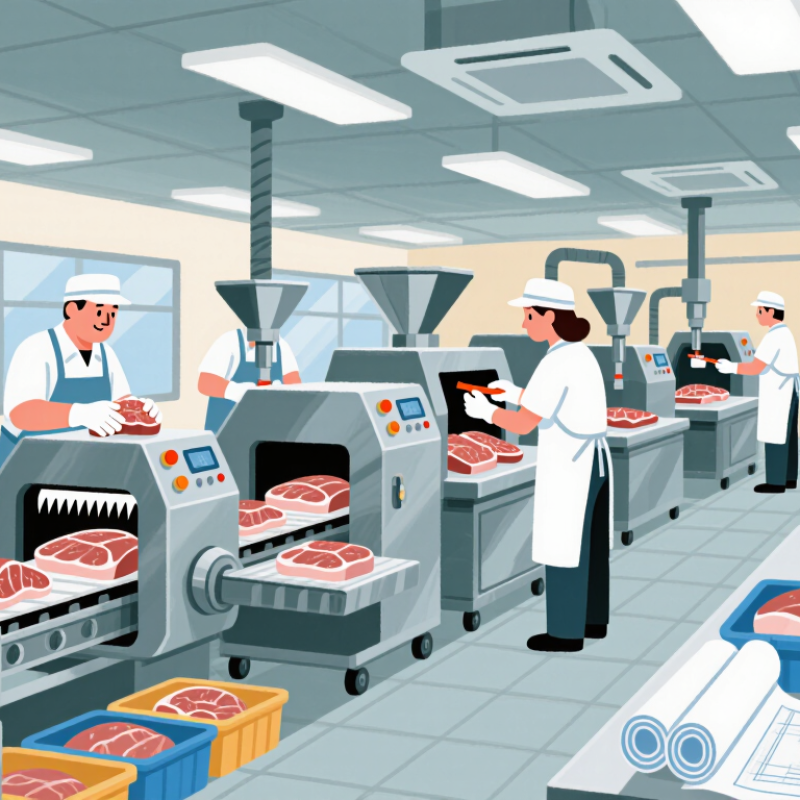
Start with the product. Fresh cuts, minced meat, and cooked products need different equipment paths. Define the cut size, texture, packaging format, and expected daily volume before comparing machines. A line designed for one product may struggle with another. Small details matter.
Set a realistic throughput target, then check it against actual shift length, cleaning time, staffing, and utility capacity. OECD-FAO’s Agricultural Outlook 2024–2033 projects global meat production to rise by 12% over the decade. That signals a changing market, not a reason to overbuy. Ask suppliers for capacity figures using your product and operating conditions, rather than relying on a headline rate. Record changeover time, trim loss, and downtime during trials.
Operating requirements matter on the floor. Measure doorways, drainage, electrical supply, and available washdown space. Confirm that operators can reach controls safely and remove parts for cleaning without awkward lifting. FAO’s State of Food and Agriculture 2023 estimated that 13.2% of food was lost between harvest and retail in 2021; the figure covers all food categories, but it underscores why yield tracking matters. Log usable output, rejects, and stoppages. I would still leave room for doubt: trial results rarely capture every messy shift.
Define your products, processing goals, and operating requirements before comparing equipment.
The chart shows illustrative relative priorities on a 1–5 scale, not equipment specifications or universal ratings. Ground products typically emphasize grinding and mixing; sausages add stuffing; cooked whole-muscle products place greater emphasis on cooking and temperature control. Confirm capacity, product temperatures, sanitation needs, utilities, and local food-safety requirements with your process and equipment suppliers.
Map the product’s actual route: receiving, inspection, cutting, grinding, mixing, forming, packing, and cold storage. Record the weight entering and leaving each step, plus changeovers, sanitation, breaks, and planned maintenance. A line rated for 1,000 kilograms per hour may not sustain that rate across a full shift. Small differences matter.
Work backward from saleable daily output. If a plant needs 4,800 kilograms of finished product during a shift, and expects 6.5 productive hours, the packing stage must average about 738 kilograms per hour. Earlier equipment may need greater capacity to cover trimming losses or uneven flow. USDA NASS reported 54.7 billion pounds of U.S. commercial red meat production in its 2023 Livestock Slaughter report. That national figure is context, not a plant design target.
Compare the required rate with each machine’s documented operating capacity, using the product type and batch size you actually expect. Check whether a mixer, grinder, or packaging station becomes the bottleneck during peak production. Then test the proposed flow with real cycle times, not just brochure rates. I would treat the estimate as provisional; paper schedules often miss small delays at handoffs. Recheck it after a trial run, and revise the capacity assumptions when actual yield or downtime differs.
Choose equipment by tracing the product, not by comparing machine specifications alone. Map each step from receiving and trimming to grinding, mixing, portioning, and packing. USDA NASS reported 2023 U.S. commercial red meat production of about 55.4 billion pounds, including roughly 26.3 billion pounds of beef and 27.8 billion pounds of pork. Those volumes highlight why capacity matters, but national totals cannot predict your plant’s peak-hour demand.
Match each machine to the material and handoff it receives. A grinder needs suitable plate options and a feed system for your cut size; a mixer needs enough usable capacity for the actual batch, not just its advertised maximum. Check changeover time, washdown access, guarding, and whether operators can clear jams safely.
Small details count. A narrow transfer chute can bottleneck an otherwise fast line. USDA NASS’s Livestock Slaughter 2023 Summary offers useful production context, but your own shift records reveal the real mix of products, batch sizes, and downtime.
Walk the workflow with operators. Note where bins wait, floors become congested, or trimming varies. A tidy process diagram can still mislead; trim bins rarely fill evenly. Keep some capacity flexibility, but question whether extra speed solves the constraint—or simply moves the queue downstream.
Choose equipment by tracing the product through every processing step. Note where meat contacts belts, blades, guards, and collection trays. Surfaces should be accessible for cleaning, with few gaps where residue can collect. Ask operators to demonstrate disassembly and reassembly during a washdown. Watch their hands and the time required. Small details matter.
Worker safety deserves a physical review, not just a specification sheet. Check whether guards stay in place during normal operation, emergency stops are reachable, and controls are clear with wet gloves. Consider lifting, repetitive motions, noise, and slippery floors around the machine. Ask maintenance staff what tasks require lockout procedures and special tools. Keep it practical.
Confirm that the equipment and its records support the hygiene and safety requirements applicable to your location. Keep manuals, cleaning instructions, inspection logs, and training records easy to find. Automation can reduce repetitive handling, but it also adds sensors, software, and maintenance needs. Match it to real production volumes and product variation; do not buy capacity you cannot use. A spotless brochure is not a factory test. Run a sample batch, observe the changeover, and note what feels awkward. That part is easy to overlook.
When choosing meat-processing equipment in 2026, the purchase price is only the visible part of ownership. Estimate energy, water, sanitation labor, wear parts, downtime, and training over a realistic production year. A lower-priced cutter may need more frequent blade changes or longer cleaning cycles. Measure both. Ask suppliers for utility use and maintenance intervals at your expected throughput, not ideal conditions. Include installation, commissioning, and operator training in the quote.
Supplier support matters most when a line stops during a busy shift. Check typical response times, local technician coverage, spare-part availability, and the clarity of service documentation. Ask how urgent faults are handled outside normal business hours. Request a sample maintenance schedule, too. A polished sales presentation is not proof of reliable service; follow up with practical questions about parts lead times and troubleshooting.
Future scalability depends on more than buying a larger machine. Check whether equipment can handle planned product sizes, added shifts, or connection to existing conveyors and controls. Allow room for safe access and cleaning, not just another machine. A capacity buffer may help, but oversized equipment can waste energy and floor space. Forecasts are often wrong, including mine; compare realistic expansion scenarios before committing.
| Equipment approach | Typical fit (single shift) | Indicative equipment budget (USD) | Installation & commissioning | Ongoing ownership costs | Staffing & operating considerations | Supplier support to verify | Scalability and best use |
|---|---|---|---|---|---|---|---|
| Standalone or semi-automatic machines Separate grinder, mixer, saw, stuffer, or packaging units | Small shop or processor; often a few hundred kilograms per day, depending on product mix and workflow | About $50,000–$180,000 for a basic multi-machine package; highly dependent on machine count and specifications | Usually lower than a connected line, but electrical work, drainage, guarding, layout, and operator training still need budgeting | More manual cleaning and handling; budget for wear parts, blades, seals, sharpening, and downtime between separate machines | More hands-on labor; flexible for short runs, varied cuts, and frequent product changes | Ask about parts availability, repair response times, manuals, operator training, and service coverage in your region | Easy to add or replace individual machines. Best when demand is modest or product variety matters more than line speed |
| Modular semi-automatic line Coordinated processing, portioning, and packaging modules | Growing operation; roughly 500–2,000 kg per day as a planning range, subject to product and changeover requirements | About $180,000–$600,000 for a configured equipment package | Allow for layout and utility coordination, controls integration, commissioning, and training across connected modules | More planned maintenance than a standalone setup; parts and service needs vary by module and operating hours | Can reduce repeated handling, but still needs trained operators for setup, quality checks, cleaning, and changeovers | Confirm whether one service team supports the full line, who handles integration issues, and what preventive-maintenance plans include | Modules can often be added or upgraded in stages. A practical choice when growth is expected but product mix remains varied |
| Integrated automated line Conveying, processing, inspection, and packaging coordinated through controls | High-volume facility; several tonnes per day may be achievable, but actual output depends on product, line balance, and uptime | About $600,000–$2,000,000+; custom layouts and extensive automation can exceed this range | Typically the highest integration burden: engineering, site preparation, controls validation, commissioning, and extended training | Higher planned-service and specialist-parts requirements; assess energy use, software support, and the cost of line downtime | May reduce manual handling per unit, while requiring staff capable of operating controls, troubleshooting, and maintaining equipment | Get written response-time targets, remote-support terms, technician availability, spare-parts lead times, and software update policies | High potential throughput, but expansion can require major layout or controls changes. Best when sustained volume justifies the investment |
Budgeting note: Price figures are indicative planning ranges in USD, not supplier quotations or guaranteed market averages. They exclude building work, land, major refrigeration or cold-storage projects, taxes, and financing. Compare proposals using the same product mix, operating hours, sanitation requirements, utility assumptions, and service scope. A useful total-ownership-cost model is purchase price + installation + training + energy and water + labor + maintenance and parts + expected downtime over the chosen evaluation period.