How to Choose Photoelectric Sensors for Your Automation Needs?
In today's automated manufacturing environment, the selection of appropriate Photoelectric Sensors is crucial. Experts emphasize the significance of this choice. For instance, John Smith, a leading authority in industrial automation, once stated, "Choosing the right Photoelectric Sensors can greatly enhance operational efficiency." This perspective highlights how pivotal these sensors are in various applications.
Photoelectric Sensors use light to detect objects, providing benefits like accurate distance measurement and reliable performance. Many companies face challenges when picking the right type. Factors such as the operational environment and the sensor mode should be considered. The need for reflection, refractive, or through-beam sensors can influence your decision.
Choosing the wrong sensor may lead to inefficiencies. Many overlook the importance of understanding their specific needs. In this evolving industry, neglecting to choose wisely can impact productivity. With the right information, you can avoid common pitfalls. Assessing both your requirements and the technological options is key in this complex landscape.
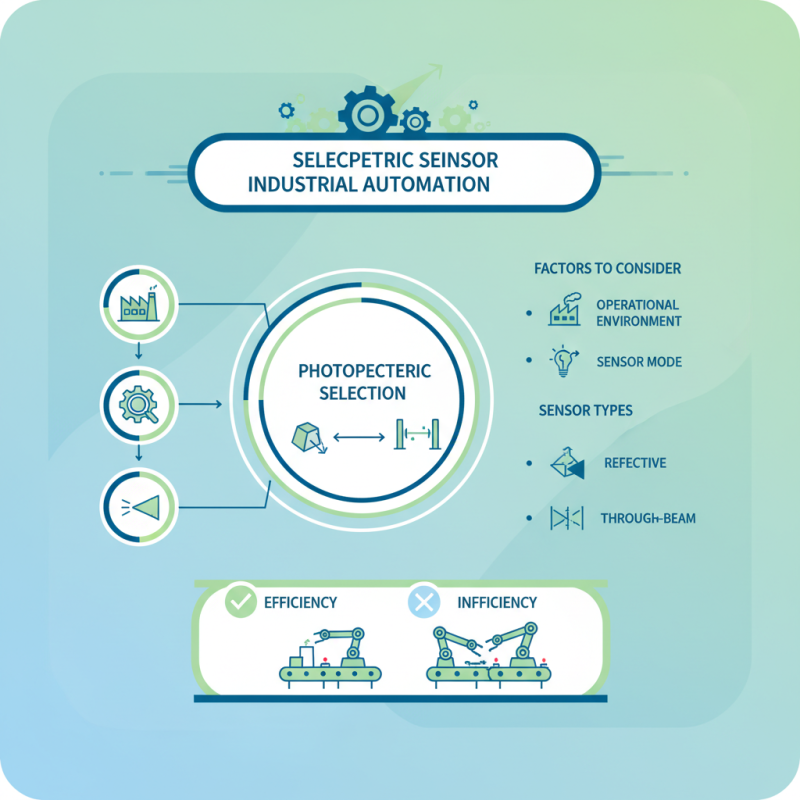
Understanding the Basics of Photoelectric Sensors in Automation
Photoelectric sensors play a crucial role in automation. They detect objects using light and are widely used in various industries. Understanding how these sensors work is key to making informed choices.
A photoelectric sensor consists of a light source and a receiver. It operates on the principle of light interruption. When an object blocks the light, the sensor signals this change. Different types of sensors offer unique advantages. Through-beam sensors are excellent for long distances, while retro-reflective ones are perfect for short-range applications. Each has its own specific use cases.
Choosing the right sensor can be challenging. Factors like detection range and environment matter greatly. Sometimes, installation can be tricky due to ambient light interference. Assessing the operational environment is vital. It's crucial to avoid making assumptions without careful evaluation. Therefore, take time to test different options before finalizing your choice.
Types of Photoelectric Sensors and Their Applications
When selecting photoelectric sensors, understanding their types is crucial. There are four main types: through-beam, retroreflective, proximity, and diffuse sensors. Each type serves different applications. Through-beam sensors operate by sending a beam from the transmitter to the receiver. They are ideal for long distances and accurate object detection.
Retroreflective sensors work with a reflector to bounce the beam back. They’re versatile in applications like packaging. Proximity sensors detect objects without touching them. They are great for safety applications in automated systems. Diffuse sensors are compact and can detect objects at shorter ranges. They are often used in conveyor systems.
Tips: Consider the distance and size of the objects in your automation process. Match the sensor's type to specific needs. Testing different sensors at your facility can yield insights. Sometimes, choices may not meet expectations. Reflecting on performance can guide future decisions. Sensor installations can be tricky; ensure alignment is perfect. Any misalignment leads to faults in detection.
Types of Photoelectric Sensors and Their Applications
Key Factors to Consider When Selecting Photoelectric Sensors
When selecting photoelectric sensors, several key factors come into play. Understand the sensing distance and its environment. This means assessing the range where the sensor can accurately detect objects. Sensors work differently in varied conditions. Dust, moisture, or reflective surfaces can impact performance. Choose the sensor type that suits your operational needs best.
Evaluate the sensing mode as well. There are reflective and through-beam options available. Reflective sensors are compact and easy to install, but they may falter in challenging environments. On the other hand, through-beam sensors offer reliability over greater distances but require more setup. It's often a balancing act between ease of installation and performance reliability.
Don't overlook connection type and networking capabilities. Some modern sensors offer advanced communication features. However, implementing them can be complicated and may require specialized knowledge. It’s essential to reflect on your team's capability to manage these technologies efficiently. Make sure to weigh the trade-offs between simplicity and complexity in your automation system.
Installation and Maintenance Tips for Photoelectric Sensors
When selecting photoelectric sensors, installation and maintenance are key factors. Ensure proper alignment during installation. Misalignment can lead to faulty readings. Use clear markers for alignment. This will save time and reduce errors.
Regular maintenance is crucial for optimal performance. Dust and debris can obstruct the sensor's view. Clean the sensor housing with a soft cloth. Check the sensor's functionality periodically to avoid unexpected downtimes. A simple test can ensure reliable operation.
Consider the environmental conditions where the sensor is located. Extreme temperatures or moisture can impact performance. Insulation or protective housing may be necessary. Always read the specifications closely. Not all sensors handle harsh conditions well. This could lead to false readings or failures. It's worth testing a few before full deployment.
How to Choose Photoelectric Sensors for Your Automation Needs? - Installation and Maintenance Tips for Photoelectric Sensors
| Sensor Type | Operating Range | Response Time | Sensor Output | Installation Considerations |
| Photoeye Sensor | 0-10 meters | < 1 ms | PNP/NPN | Line of sight clear of obstructions |
| Laser Sensor | 0-25 meters | < 500 µs | Digital | Potential surface reflectivity issues |
| Capacitive Sensor | 0-15 mm | < 1.5 ms | Analog | Must consider the material type of target |
| Inductive Sensor | 0-30 mm | < 1 ms | PNP/NPN | Short-range for metallic targets |
| Ultrasonic Sensor | 0-6 meters | < 20 ms | Analog/Digital | Avoid ultrasonic noise interference |
Common Challenges and Solutions in Using Photoelectric Sensors
Choosing the right photoelectric sensor can be tricky. Many engineers face common challenges during this process. For instance, environmental factors like dust or moisture can hinder sensor performance. According to a recent industry report, nearly 30% of sensor failures are linked to these environmental conditions. It's essential to assess the installation area carefully.
Understanding the light type is also crucial. Photoelectric sensors can use laser, LED, or fiber optics. Each type has its advantages and disadvantages. For example, laser sensors offer high precision but may struggle in bright light. In contrast, LED sensors can be versatile, yet they may not perform well in long-range setups. A comprehensive study highlighted that about 40% of users underestimated these factors.
Another challenge is wiring complexity. Improper wiring can lead to malfunction, which impacts automation efficiency. Experts suggest that over 15% of setups experience issues due to wiring errors. They recommend developing a clear wiring plan before installation. This proactive approach can mitigate common mistakes and enhance overall system reliability. Addressing these challenges early improves sensor performance and extends service life.