

Top 10 Roller Table Conveyor Manufacturers Worldwide

A Roller Table Conveyor can look simple: steel rollers, a sturdy frame, and a motor or gravity doing the work. Yet small design choices matter. Roller diameter, load capacity, spacing, and drive type affect how smoothly goods move between workstations. A poorly matched conveyor can slow a line or make transfers awkward.

This guide introduces ten manufacturers with a worldwide presence in material handling. It considers practical factors such as product range, customization, engineering support, industry experience, and service availability. These details can help buyers compare suppliers for packaging lines, warehouses, production floors, and other operations. A polished catalog is useful, but real performance depends on the application.

There is no universal best choice. Not every manufacturer serves every region or handles every load profile equally well. Specifications should be checked against actual package dimensions, weight, throughput, and site conditions. Ask about installation needs, replacement parts, and maintenance access, too. Those questions are easy to overlook.

The ranking is a starting point, not a final verdict. Company capabilities and product offerings can change, while public information may not reveal every limitation. Use the list to build a shortlist, then confirm details directly with manufacturers. A careful comparison often beats a fast decision.
Top 10 Roller Table Conveyor Manufacturers Worldwide

Understanding Roller Table Conveyors and Their Industrial Role

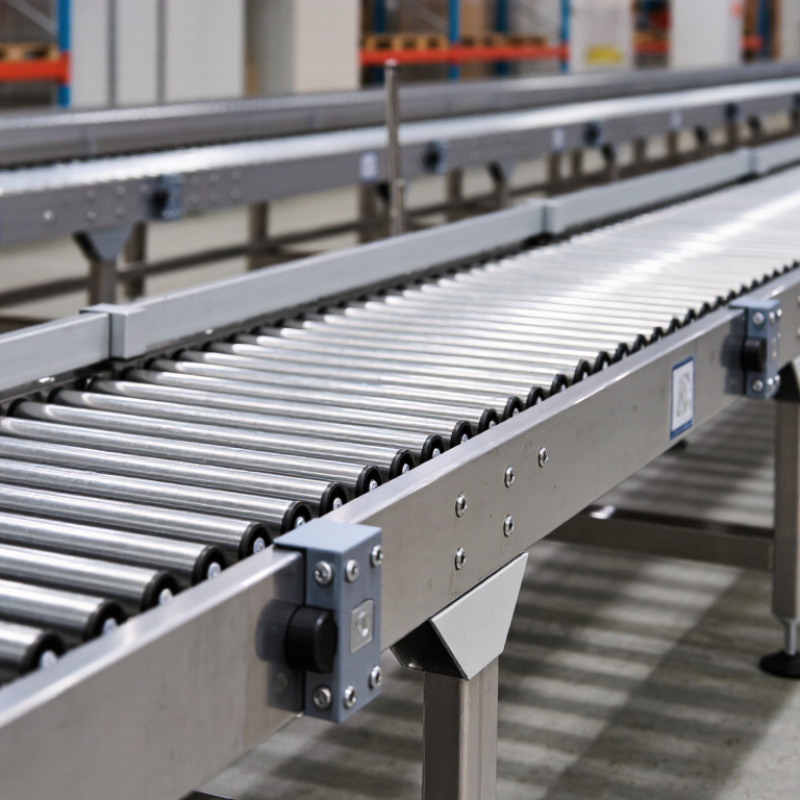
Roller table conveyors move cartons, totes, and rigid packages across powered or gravity-driven rollers. Their open structure makes loads easy to inspect and helps workers spot jams quickly. In a distribution center, a parcel may cross several roller zones before reaching sorting or packing. Small design choices matter: roller pitch must support the shortest load, while frame height and transfer points affect safe, steady movement. They are not suitable for every product. Soft bags can sag between rollers, and unstable loads may turn or slip.

The industrial role is broader than transport. Roller tables connect workstations, buffer uneven production rates, and reduce repeated manual handling. MHI and Deloitte’s 2024 Annual Industry Report found that 55% of surveyed companies planned to invest more than $1 million in supply-chain innovation over the following two years. That figure reflects wider automation interest, not conveyor purchases alone. It is an important distinction. In practice, a conveyor’s value depends on throughput, maintenance access, noise, and how well it fits existing processes. A neglected bearing can stop a line; yet adding automation without studying real load patterns can create new bottlenecks. Engineers should assess the actual packages, operating shifts, and cleaning needs before selecting a system.

Top 10 Roller Table Conveyor Manufacturers Worldwide — Understanding Roller Table Conveyors and Their Industrial Role

Roller diameter is one of the basic dimensions considered when specifying a roller table conveyor. The values shown are examples of commercially used nominal diameters, not a universal standard; the right choice depends on factors such as conveyed load, roller spacing, and operating conditions.

How Global Roller Table Conveyor Manufacturers Are Evaluated

Comparing roller table conveyor manufacturers starts with the workpiece, not a catalogue photograph. Record its width, mass, underside shape, and temperature at the transfer point. Check roller spacing against the smallest item; wide gaps can let narrow parts dip or snag. Details matter.

Review load charts, duty-cycle limits, roller and shaft specifications, bearing access, and drive arrangements. Ask how the supplier validates capacity under realistic operating conditions. A test with your own product can reveal skew, vibration, or poor transfers that a drawing may miss. Test it loaded. Also examine weld consistency, finish, and access to lubrication points; small defects can become maintenance headaches.

Reliable evaluation includes delivery and support, not just equipment design. Request documented inspection procedures, spare-part lead times, and references for similar material sizes and operating hours. Compare answers in writing, since vague assurances are difficult to verify later. A polished demonstration is useful, but it is not the whole picture. Even a careful trial cannot reproduce every shift, dust level, or operator habit. That limitation deserves attention.

Profiles of 10 Leading Roller Table Conveyor Manufacturers Worldwide

Worldwide roller table conveyor manufacturers differ less by appearance than by the problems they solve. These ten capability profiles offer a practical way to compare suppliers, rather than a verified ranking. Strong manufacturers specify load limits, roller spacing, frame materials, and operating conditions clearly.

One profile focuses on heavy steel frames for dense, weighty products. Another builds modular sections that maintenance teams can replace quickly. A third specializes in custom transfer tables and line integration. Some concentrate on powered rollers for controlled accumulation; others supply gravity tables for simple, low-maintenance movement. Check the details.

Several manufacturers stand out through application-specific engineering. One serves food and packaging facilities with cleanable surfaces. Another designs compact systems for warehouse picking areas. A further profile supports automotive lines, where repeatable positioning matters. Mining and metalworking suppliers prioritize impact resistance and robust bearings. Regional fabricators may offer short lead times and easier on-site support, though their documentation can vary. Ask for drawings, duty-cycle guidance, spare-parts availability, and references for similar loads before comparing quotes. A polished catalogue is useful, but it cannot replace evidence from an operating installation.

Key Technologies and Applications Across Manufacturer Offerings

Roller table conveyor designs differ most in how they handle friction, spacing, and changing loads. Gravity rollers suit cartons moving down a slight incline, while powered rollers provide controlled movement on level lines. Zoned accumulation uses sensors to pause one section without stopping the entire conveyor. Variable-speed drives can reduce abrupt starts, which helps protect fragile packages and keeps loads from bunching near transfer points. Small details matter.

Grand View Research’s 2024 Conveyor System Market Size, Share & Trends Analysis Report estimated the global conveyor systems market at USD 10.6 billion in 2023, with a projected 4.5% compound annual growth rate through 2030. This figure covers conveyor types beyond roller tables, so it signals broader investment rather than roller-specific demand.

Across manufacturer offerings, buyers should compare roller diameter, frame stiffness, sensor placement, and control compatibility against actual carton weights and line speeds. A conveyor that works well with uniform boxes may struggle with soft packages or uneven bases. That is easy to overlook. Specifying a generous speed range can help, but it may add control complexity and maintenance points. Pilot testing with real loads remains more useful than relying on catalog capacity alone.

Factors to Consider When Choosing a Roller Table Conveyor Manufacturer

Choosing a roller table conveyor manufacturer starts with the load, not the catalog. Record the heaviest item, its base width, and the smallest package. Ask for roller pitch and diameter calculations for those exact dimensions. A carton that bridges only two rollers may wobble or stall. Test the actual product, if possible.

MHI’s 2024 Annual Industry Report found that 55% of surveyed organizations were increasing supply-chain technology investment. The report also found that 88% expected investment to rise over five years.

These figures cover supply-chain technology broadly, not conveyors alone, but they underline the value of planning for future integration. Ask whether the manufacturer can document throughput, accumulation behavior, noise, and power needs under your operating conditions. Request a written load-test method. Details matter.

Check frame materials, bearing access, spare-part lead times, and cleaning requirements for your facility. Ask how the supplier handles installation, operator training, and service after commissioning. A polished drawing cannot reveal every site constraint.

That part deserves reflection. Compare references from facilities with similar loads and duty cycles, not just similar floor plans. Review warranty exclusions closely, and confirm which wear parts are stocked locally.

If the proposed system has no clear maintenance access, a low purchase price may become costly downtime. Some specifications will still change after a site survey; document assumptions before approving the design.